Introduction
When choosing an internet service provider, speed and reliability are often the top priorities. Two of the most common technologies available to households and small businesses are cable internet and DSL. Both have their strengths and weaknesses, but one crucial factor that often decides the winner is speed. In this cable internet vs DSL speed comparison, we’ll break down how each technology works, their real-world performance, and which option may be the better fit depending on your needs. By the end, you’ll have the clarity to make an informed decision that supports your browsing, streaming, or remote working requirements.
Understanding the Basics of Cable Internet and DSL
Before comparing speeds, it helps to understand what these technologies are and how they deliver internet access.
What is Cable Internet?
Cable internet uses the same coaxial cables that deliver cable television. Because coaxial cables have high bandwidth capacity, they can transmit large amounts of data at much higher speeds. This makes cable internet particularly popular in urban and suburban areas where cable TV infrastructure is widely available.
What is DSL Internet?
DSL, short for Digital Subscriber Line, delivers internet through traditional copper telephone lines. Unlike dial-up, DSL allows simultaneous use of both phone and internet services. Although DSL is more widely available in rural areas, it generally offers slower speeds compared to cable, especially as distance from the provider’s central office increases.
Cable Internet vs DSL Speed Comparison
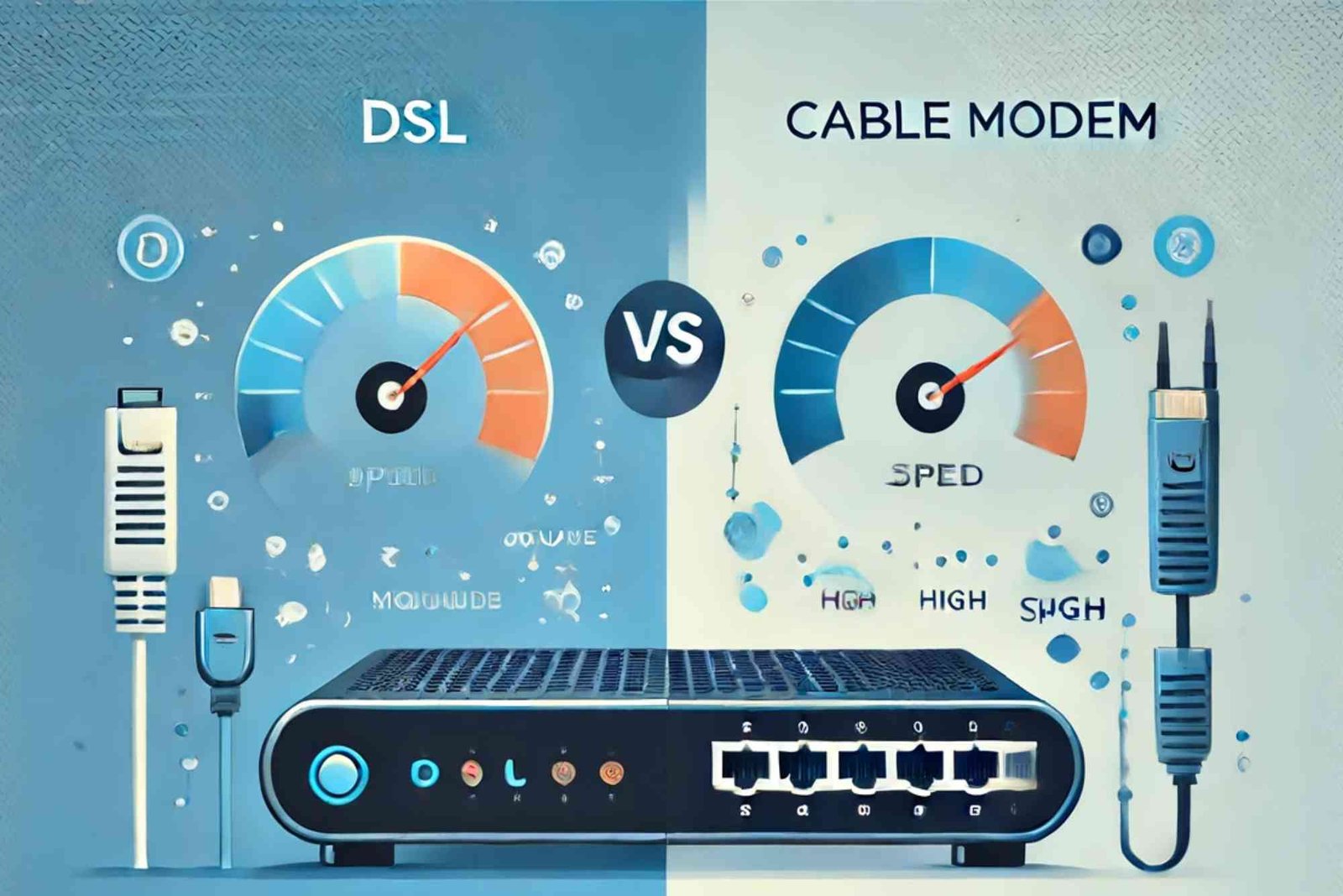
Now that the basics are clear, let’s dive into the cable internet vs DSL speed comparison and see how they perform in real-world scenarios.
Download Speeds
Cable internet usually ranges from 25 Mbps to 1 Gbps, depending on the plan and provider. DSL, on the other hand, often maxes out at 100 Mbps, with many plans offering only 5–35 Mbps. For households with multiple devices streaming HD or 4K video, cable internet clearly has the edge.


Upload Speeds
Upload speeds are critical for video calls, cloud storage, and online gaming. Cable internet typically offers 5–50 Mbps upload speeds, whereas DSL tends to lag behind at 1–10 Mbps. While sufficient for light use, DSL may struggle with demanding applications like live streaming or frequent file sharing.
Latency and Stability
Latency affects online gaming, video conferencing, and real-time applications. DSL sometimes offers slightly lower latency due to its direct line connection. Cable, however, can experience network congestion during peak hours when many households share the same bandwidth. Still, in most cases, the difference is negligible for average users.
Factors Affecting Speed Performance
Network Congestion with Cable
Because cable internet users in a neighborhood often share the same network, peak evening hours can slow speeds. For instance, streaming a movie at 8 PM might feel slower than at 10 AM.
Distance Limitations with DSL
DSL speed depends heavily on your distance from the provider’s central office. The farther you are, the weaker the signal and the slower the speed. This makes DSL a less consistent option for households on the outskirts of town.
Equipment and Infrastructure
Modems, routers, and wiring also impact performance. Even with a fast cable plan, outdated equipment can bottleneck speeds. DSL, being based on older copper lines, naturally faces more limitations than cable’s coaxial infrastructure.
Cost vs Speed: Which Offers Better Value?
DSL is usually more affordable, making it appealing for budget-conscious users who only need basic browsing and email. However, for households that depend on high-speed internet for streaming, online classes, or remote work, cable internet provides far better value for money.
When comparing cost-per-megabit, cable internet often delivers more speed for each dollar spent, even though the monthly bill might be slightly higher than DSL.
Reliability in Different Locations
In cities, cable internet is almost always superior due to its high speeds and strong infrastructure. In rural or remote areas, however, DSL might be the only option. That said, newer technologies such as fiber and satellite are gradually expanding to fill those gaps, but in many places, the choice still comes down to cable vs DSL.
Future Outlook: Will DSL Survive?
As technology evolves, DSL is slowly being phased out in many areas. Providers are investing more in cable and fiber-optic networks. Fiber, in particular, offers lightning-fast speeds and symmetrical upload and download rates. While DSL will continue serving some rural communities, the long-term trend favors cable and fiber as the future of internet connectivity.
Which One Should You Choose?
If speed is your top priority, cable internet almost always wins the cable internet vs DSL speed comparison. For casual users who browse, email, and stream occasionally, DSL may still be sufficient. However, for families, gamers, or remote workers, cable internet provides the performance needed to stay connected without frustration.
If you’re located in Pakistan and searching for reliable connectivity, providers such as Dhanote Internet Services offer packages that combine affordability with fast speeds, ensuring a smooth online experience.
FAQs
Is cable internet always faster than DSL?
Yes, in most cases cable internet is faster, with download speeds reaching up to 1 Gbps, compared to DSL’s 100 Mbps limit.
Why is DSL slower than cable internet?
DSL relies on older copper telephone lines, which have limited bandwidth compared to coaxial cables used in cable internet.
Does DSL have any advantages over cable internet?
DSL can sometimes provide lower latency and is less affected by peak-hour congestion, though speeds are still lower.
Which is better for gaming: DSL or cable internet?
Cable internet is better for gaming due to higher download and upload speeds, although very stable DSL connections may suffice for light gaming.
Will DSL be phased out completely?
Over time, yes. Many providers are moving away from DSL in favor of cable and fiber, which offer far greater speeds and reliability.
When looking at a cable internet vs DSL speed comparison, the results are clear. Cable internet offers higher speeds, better value, and more reliable performance for most modern households. DSL may work for light users or rural areas, but its limitations make it less future-proof.